An eye is useless until all its parts, and the brain behind it, are in place, so it could not have been built in small steps. The simpler eyes of living animals are complete eyes in their own right, not stages on the way to ours.
The short answer
Partial eyes are in use today. A box jellyfish larva steers by light with no nervous system, a ragworm larva with a two-cell eyespot, a flatworm with a pigment cup, a nautilus with a lensless pinhole and a sea star with lensless eyes on its arm tips. Each does a real job, and a deliberately slow calculation finds small improvements could turn a light-sensitive patch into a camera eye in under 400,000 generations.
The objection is older than modern creationism. In 1871 the zoologist St George Mivart argued that natural selection cannot account for the “incipient stages” of useful structures, and he listed the eye among his cases.1 The parts of the eye form together in the embryo, he wrote, and such co-ordinated parts are useless “until so far developed as to effect the requisite junctions”.2 He also quoted J. J. Murphy, who argued that the more parts an organ has, the more variations must occur at once, and who put the odds of ten such variations coinciding at 1 in 10³⁰.3
Modern versions build on this. Jonathan Sarfati argues that even the simplest light-sensitive spot is biochemically complex, that detecting light is useless without neural processing to act on it, and that “it is also fallacious to point to a series of more complex eyes in nature” as though it were an evolutionary sequence.4 Ken Ham makes a similar point about the series of living eyes: each is “a fully formed and functioning eye”, and an eye also needs a brain, protective fluid and transparent skin before it is any use.5
Darwin raised the same difficulty in 1859 and answered it with a graded series of eyes, each useful to its owner.6 How his words are often quoted is the subject of the claim page “Darwin admitted the eye was absurd”.
The evidence
Simple eyes do real work
Biologists sort light-guided behaviour into four classes of rising demand: monitoring light levels, telling the direction of light, low-resolution vision and high-resolution vision.78 Each class matches a stage of eye structure, from an unshielded receptor to a shaded one, a pigment cup and finally an eye with focusing optics.9 Working from the minimum performance each task needs, Nilsson and Bok (2017) argue that photoreceptors evolved through these classes in that order, simple roles before demanding ones.10
Living animals use eyes at every one of these stages (Chapter 4, sections 4.2–4.6). The larva of a box jellyfish steers with about 20 ocelli, each a single cell, and has no nervous system at all.1112 In the larva of the ragworm Platynereis, an eyespot of two cells, a photoreceptor and a pigment cell that shades it, steers the larva through a direct nerve connection to the cilia it swims with.13 A planarian flatworm’s pigment-cup eye resolves only about 35° per receptor.14 The lensless pinhole eye of Nautilus separates objects about 5.5°–11.25° apart.15 Giant clams carry pinhole eyes with a 16.5° view per receptor, and close up when a shadow or a large enough object passes.16
FIG. 1Six eyes in use today, from a single light-sensitive cell to a focused camera eye. Each does a job for its owner. These are separate living animals, not a line of ancestors.Drawing: Half an Eye, CC BY 4.0. After Land & Nilsson 2012, figs 1.4 and 4.1, and Nilsson & Pelger 1994, fig. 2.
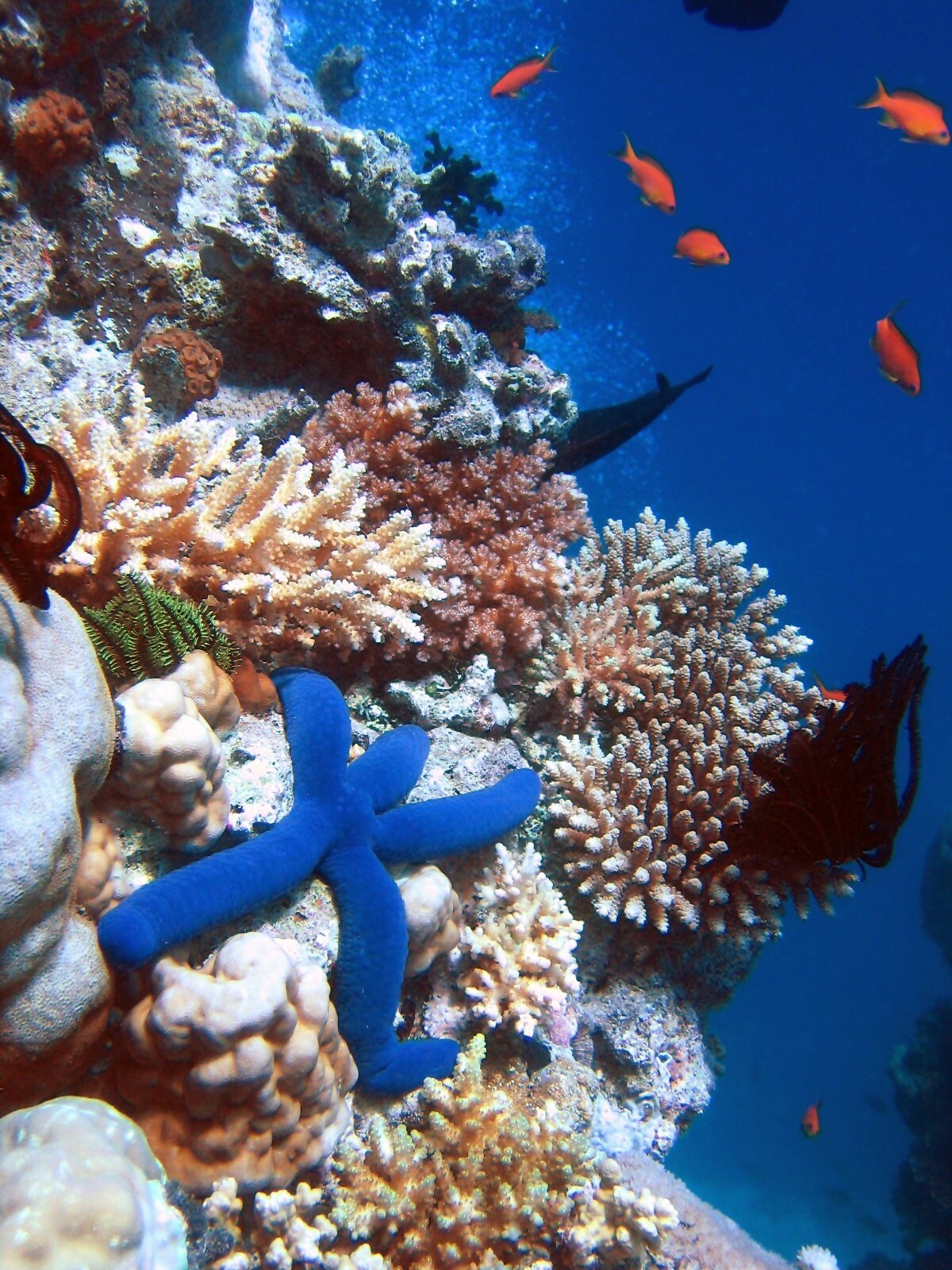
The blue sea star, Linckia laevigata, has a compound eye at each arm tip with no true optics.17 These eyes form images, though at low resolution, and in displacement experiments only animals with intact eyes found their way back to the reef.17 Box jellyfish go a step further: their lens eyes are deliberately out of focus, yet they guide the animals around mangrove roots and home by the canopy seen through the water surface (Chapter 4, section 4.6).181920
FIG. 2Blue sea star, Linckia laevigata, on the Great Barrier Reef. It carries a small compound eye at the tip of each arm, too small to see here.Photo: Richard Ling, via Wikimedia Commons, CC BY-SA 2.5.
Eyes do not need a brain first
The simplest of these systems work without a brain. The box jellyfish larva has no nervous system: each light-sensing cell steers the larva itself.11 The ragworm larva’s eyespot drives its cilia directly.13 When the larva grows its later eyes, of 2–7 photoreceptors each, they are served by a circuit of 71 neurons and 1,106 synapses that compares light on the two sides of the body.21 The eye and the wiring behind it are equally simple at the start.111321
Small steps add up
Land and Nilsson state that an eye can evolve gradually, without sudden changes, from the simplest light sensitivity to a focused eye, with each modification giving a small improvement.22 Nilsson and Pelger (1994) tested this with a calculation. A flat patch of light-sensitive cells reaches a focused camera-type eye in 1,829 steps of 1%, and resolution improves throughout, with no stretch where change brings no gain (Chapter 4, section 4.8).23 They changed one structure at a time and never two in parallel, to keep the estimate slow; Murphy’s objection assumed the opposite, that many changes must coincide.233 Even so, the whole sequence takes about 364,000 generations.23 Field measurements of heritability and selection in wild animals suggest these inputs were cautious (Chapter 4, section 4.9).2425
The parts are older than the eye
The light-sensing machinery predates eyes. The last common ancestor of all animals, possibly excluding sponges, very likely had a light-sensing opsin that signalled through a G-protein cascade, and that family of receptor proteins evolved before animals did.26 Lens proteins, the crystallins, were recruited from proteins that already had other jobs, mostly enzymes and stress proteins, and some are the very same gene product as an enzyme.272829 Neither the light sensor nor the lens material was invented from nothing for the eye.2627
Eyes evolved more than once
Many types of photoreceptors, eyes and visual roles evolved independently in different animals, in a pattern guided by what each task requires.30 The common ancestor of bilaterian animals had pigmented photoreceptor cells but no image-forming eyes, and sophisticated multi-purpose eyes evolved separately in spiders, insects and crustaceans, cephalopods and vertebrates (Chapter 7).31
Where the claim has a point
Living eyes are not ancestors. Sarfati is right that a nautilus is not an ancestor of vertebrates, and that lining up living eyes does not show a line of descent.4 Darwin made the same point: an organ’s direct ancestors can “scarcely ever” be traced, so the series has to come from living species of the same group.32 The argument needs only that each stage works, and in molluscs alone living species carry pigment cups, pinholes, under-focused lens eyes and camera eyes.3334 Land and Nilsson describe these intermediates as end products: in each lineage, selection for sharper vision stopped where more visual information could not improve the animal’s behaviour.35 Ham’s observation that each living eye is complete and functioning is, in this sense, what the evolutionary account predicts.535
The nautilus may not be primitive. Two genome studies suggest the lensless Nautilus eye may have lost parts rather than never gained them.3637 This book uses it as proof that a pinhole eye works, not as an ancestral stage.
The famous calculation has limits. Nilsson and Pelger modelled only the optics of the eye, started with photoreceptors already present and left neural processing outside the model.38 It was an analytical calculation, not the computer simulation it is often called, including by Sarfati.438 Its role is to show that the optical sequence needs no impossible leap and no long time, not to reconstruct a whole animal. The claim page “Nilsson and Pelger was not a real simulation” covers it in detail.
Light sensing is biochemically complex. That is true, and the origin of that machinery is covered in Chapter 2.26 It does not bear on whether a light-sensitive patch could become a camera eye in useful steps.